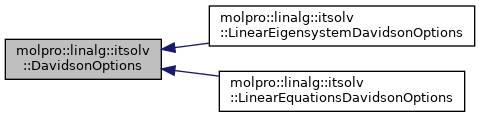
#include <DavidsonOptions.h>
◆ DavidsonOptions() [1/2]
| molpro::linalg::itsolv::DavidsonOptions::DavidsonOptions |
( |
| ) |
|
|
default |
◆ DavidsonOptions() [2/2]
| molpro::linalg::itsolv::DavidsonOptions::DavidsonOptions |
( |
const options_map & |
opt | ) |
|
◆ contrib_thresh
| std::optional<double> molpro::linalg::itsolv::DavidsonOptions::contrib_thresh |
◆ hermiticity
| std::optional<bool> molpro::linalg::itsolv::DavidsonOptions::hermiticity |
◆ max_size_qspace
| std::optional<std::size_t> molpro::linalg::itsolv::DavidsonOptions::max_size_qspace |
Maximum number of vectors kept in the Q space; older vectors are folded into the D space. Default: unlimited. A limit bounds memory and disk use, but slows convergence of hard problems, and without reset_D small limits can prevent convergence altogether, so set reset_D (e.g. 10) together with it. For linear equations with an indefinite matrix, a limited Q space can make the projected problem nearly singular, so that the solution diverges (#628).
◆ min_size_qspace
| std::optional<std::size_t> molpro::linalg::itsolv::DavidsonOptions::min_size_qspace |
Minimum number of vectors kept in the Q space when it is truncated. Default: 0.
◆ norm_thresh
| std::optional<double> molpro::linalg::itsolv::DavidsonOptions::norm_thresh |
◆ reset_D
| std::optional<std::size_t> molpro::linalg::itsolv::DavidsonOptions::reset_D |
Every reset_D iterations, discard the D space and move the current solutions into the Q space. Default: never.
◆ reset_D_max_Q_size
| std::optional<std::size_t> molpro::linalg::itsolv::DavidsonOptions::reset_D_max_Q_size |
Maximum size of the Q space immediately after a D-space reset. Default: unlimited, but never more than max_size_qspace.
◆ svd_thresh
| std::optional<double> molpro::linalg::itsolv::DavidsonOptions::svd_thresh |

 1.9.8
1.9.8